
HLT™MEDBEDS
A premium wellness-technology platform, presented for evidence-gated investment.
MedBeds HLT™, in depth.
Part B is the heart of this portfolio: nineteen chapters on the HLT product, platform, financial model and capital programme. Parts A and C summarise Yalkoneh Engineering and its wider humanitarian portfolio. Hover a chapter to glimpse it; select it to travel there.
MedBeds HLT™ · Product
Yalkoneh Engineering.
A humanitarian project management company that turns validated technology and proven partners into hospitals, farms, water systems and infrastructure.
Rooted in Yalkoneh Business Group, a Grade I contractor in Ethiopia since 2004, and in Yalkoneh Consulting & Engineering in the United Kingdom. Its science partner, the Jalisco Foundation of Mexico, has generated, validated and transferred agricultural, aquaculture and forestry technology since 1996. The portfolio runs along two humanitarian corridors from four offices, and MedBeds HLT™ leads it.
- 01Medical tourism destination
- 02Health, wellness & nutrition
- 03National food security
- 04Food preservation
- 05Agricultural technology
- 06Water security
- 07Ocean & coral restoration
- 08Forest & water management
- 09Infrastructure
- 10Zoo, wildlife refuge & park
The people behind the platform.
Builders, scientists, engineers and storytellers, assembled to take a premium product from concept to corridor network.


Yalem Meressa Girmay
Founder and CEO of Yalkoneh Business Group, a Grade I contractor that since 2004 has built hospitals, hotels, high-rises, shopping centres, highways and bridges across Ethiopia. Former President of the Ethiopian Contractors Association and Chairman of the Jalisco Foundation Advisory Board. Civil engineer (Addis Ababa University); BA Accounting & Finance (University of North London); MBA, Construction Technology Management (University of East London).


Dr. Gabriel G. Castro Cavazos
For 25 years Chairman & CTO of the Jalisco Foundation. PhD in Agriculture and Biology (University of Guadalajara, Weizmann Institute, Wageningen University). Over ten years as Chief Agriculture Adviser to the German Government.


Roy Lengweiler
Independent structural engineer (Dipl. Ing. ETH) specialising in cable-stayed bridges. Landmark work includes the Rama VIII Bridge (Bangkok), the Sheikh Zayed Bridge (Abu Dhabi) and the Plaridel Bypass (Manila).


Yusuf Aslam
A rich history within the IT and marketing industry, with interests in architecture, Web3, digital marketing, social media, AI technology, the energy sector, blockchain & DLT, and app and web applications.
David A. Sinacola
Over 50 years in construction project management, hospitality and themed development, including projects valued above US$3 billion each; creative force behind Rock & Waterscape and The Fountains at Bellagio water features.

HEALTH ·
LONGEVITY ·
TECHNOLOGY
The product, the platform, the numbers and the gates: everything an investor needs to begin diligence on HLT.
The product enters the investment case.
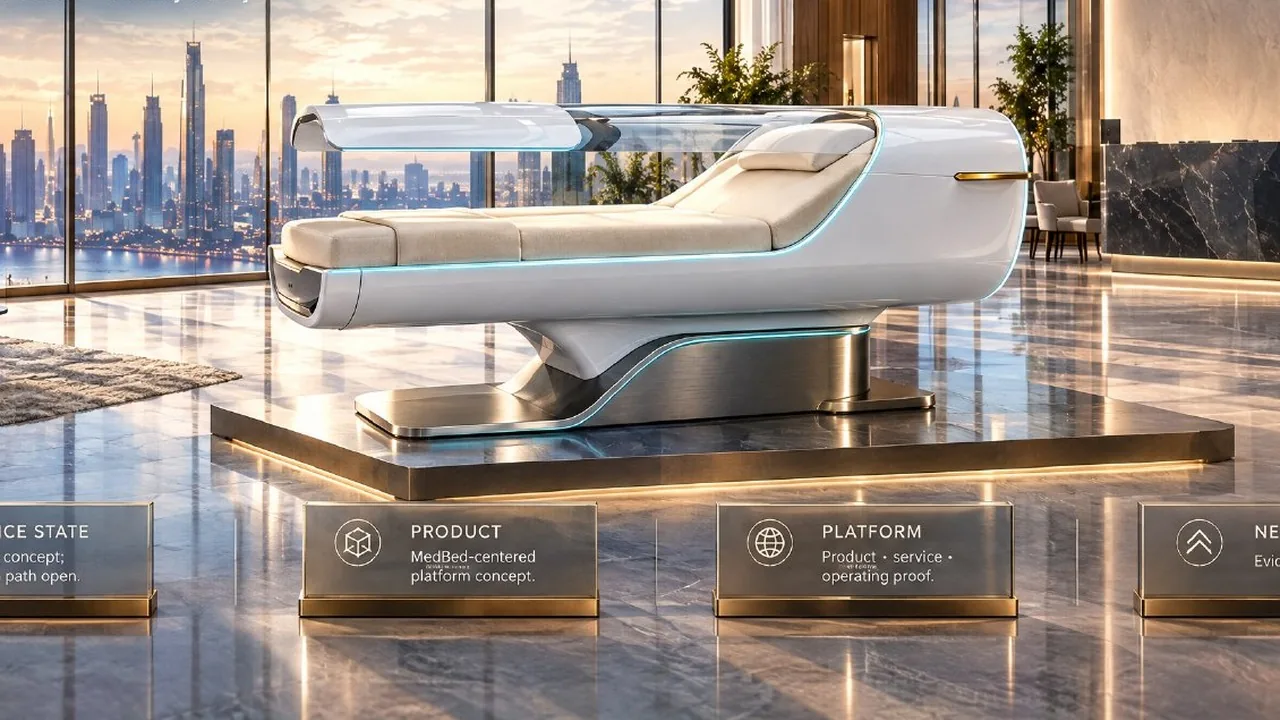
HLT (Healthy Life Technology) is a proposed flagship wellness-technology experience built around the MedBed, a premium, serviceable wellness platform, informed by an institutional feasibility study.
HLT is not a pre-revenue idea. It is an operating company with roughly US$2 million of annual commercial throughput reconstructed from bank records, existing operations in Virginia, and a capitalisation plan that releases money only as evidence arrives.
The MedBed anchors the platform; the platform is the work around it: the flagship, commerce, suppliers, B2B packages, service and consent-based data. Each is proven in sequence before capital moves to the next.

The HLT MedBed.
A next-generation wellness platform concept for premium markets worldwide, designed around science, design and scale. Tap the gold points to explore it.
Premium upholstery01
Breathable, durable and comfort-engineered for extended sessions.
Ergonomic design02
Adaptive contours for natural alignment and personalised comfort.
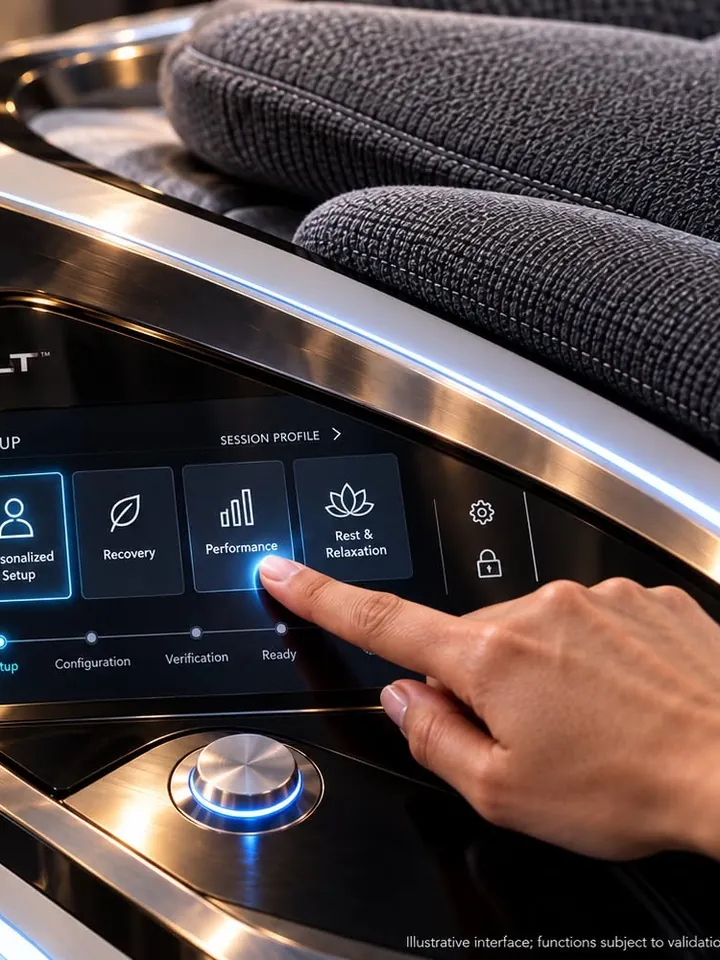
User-interface zone03
Intuitive touch controls with personalised session profiles: setup, recovery, performance, rest & relaxation.
Advanced structure04
A precision-built platform designed for stability, safety and long-term reliability.
Service access05
Designed for efficient maintenance and support.
Assess
Health & biomarker analysis
Personalise
AI-guided wellness programmes
Restore
Recovery sessions
Perform
Energy, resilience, vitality
Live longer
More healthy years
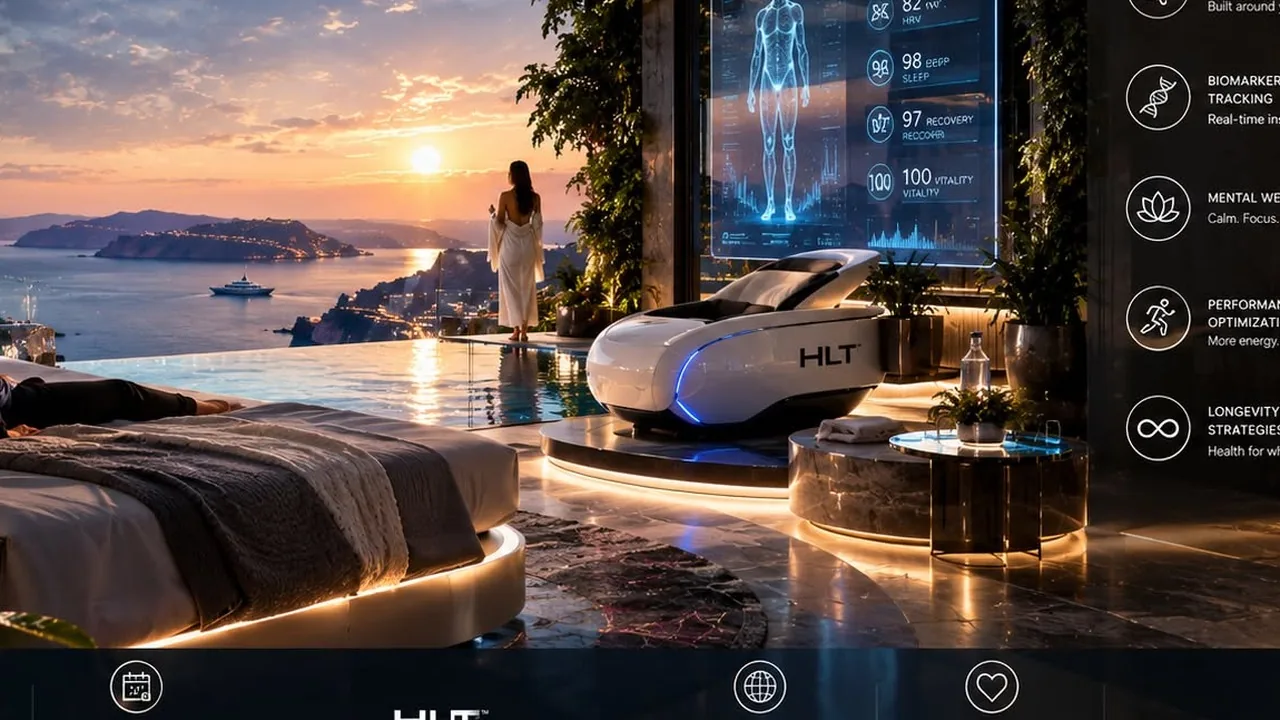
Illustrative concept renders; interface functions subject to validation. No medical efficacy claim is made ahead of validation and regulatory review.
Your wellness, your way.


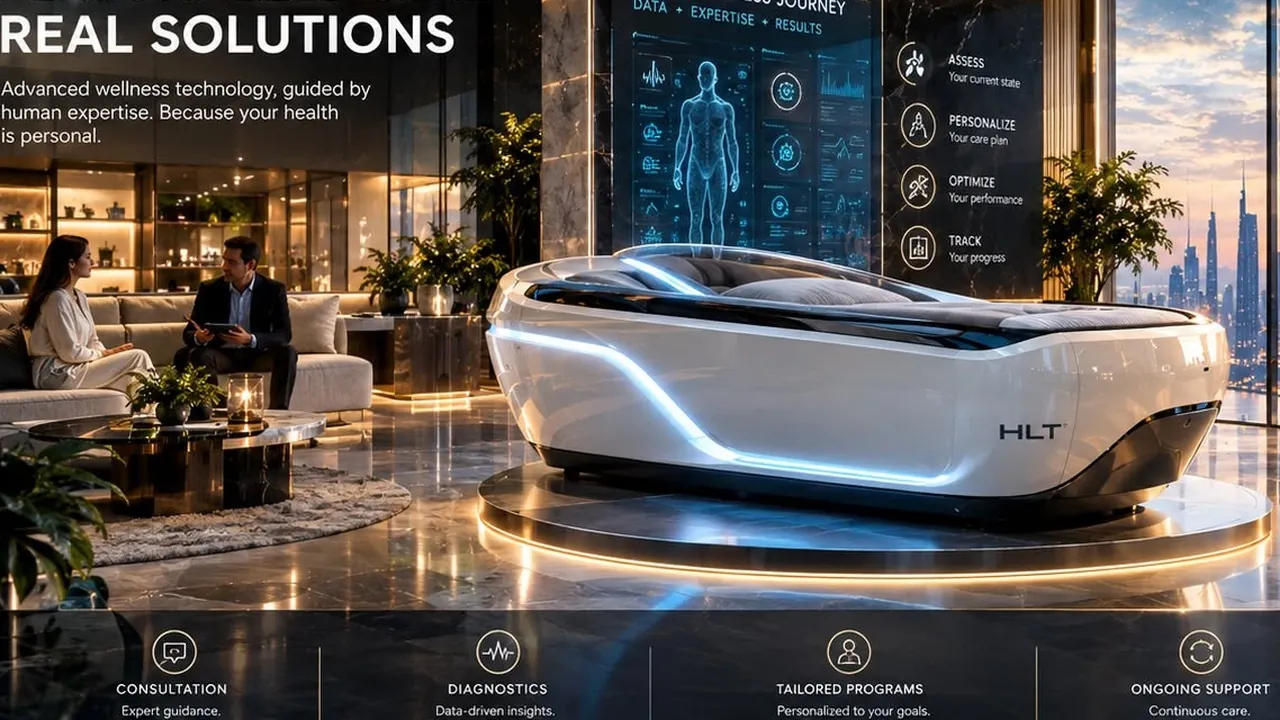


Engineered to be serviced. Built to last.
A MedBed fleet is only as valuable as its uptime. Every unit is designed to be inspectable, serviceable and accountable, so service becomes a recurring revenue line of its own.
The product passport is the first release condition.
Before HLT moves to product-forward release, every MedBed configuration carries a passport: an evidence archive of who makes it, who sells it, what it is for and what may be said about it.
Configuration
The exact build, options and software version of each MedBed.
Role
Who is manufacturer, importer and seller, and what each is responsible for.
Intended use
What the product is for, and what it is not for.
Supply
Approved suppliers, terms and lead times.
Warranty
What is covered, for how long and by whom.
Service
Service schedule, parts and who performs the work.
Quality
Inspection standards and acceptance criteria.
Safety documentation
The safety file that travels with every unit.
Rights
Who owns or licenses the design, brand and content.
Claims review
Every statement about the product, cleared before use.
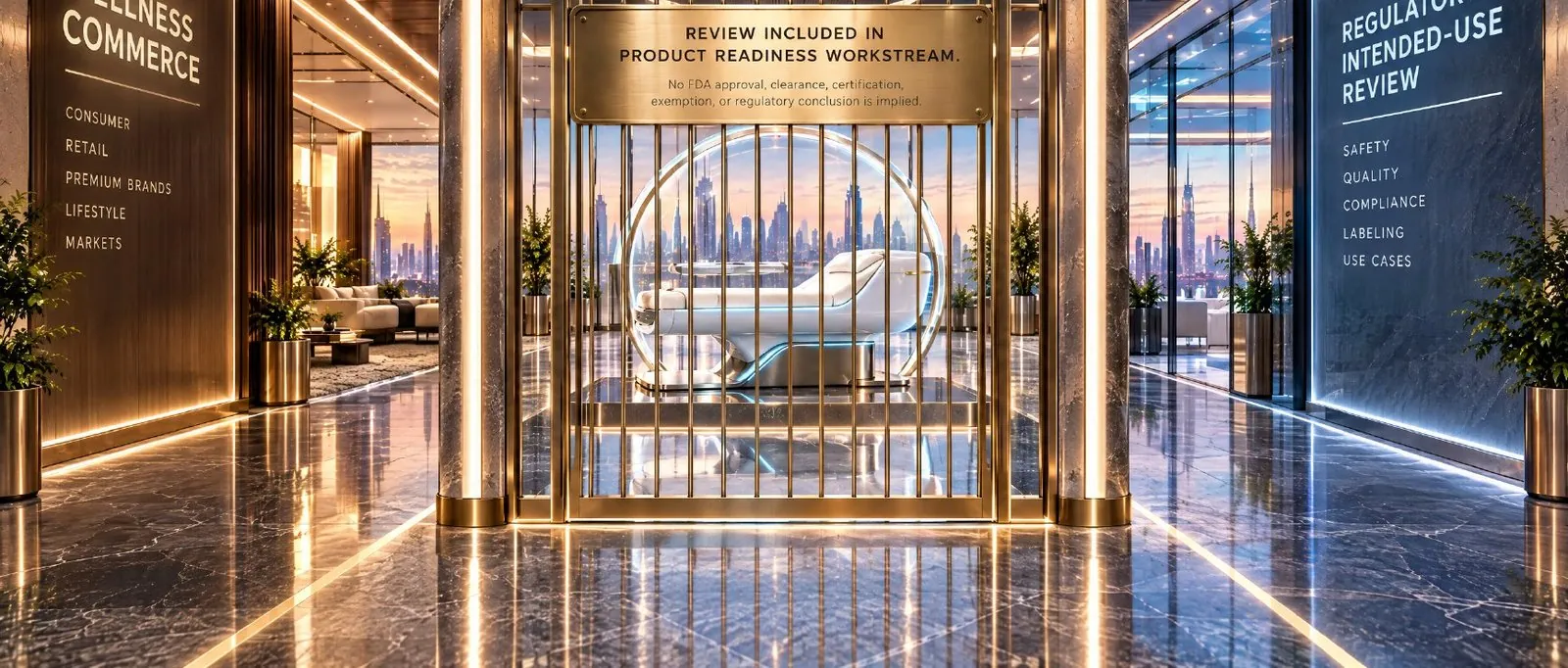
Design language cannot resolve product classification.
The review is part of the product-readiness workstream. No FDA approval, clearance, certification, exemption or regulatory conclusion is implied.
Claims and rights are release gates.
Every film, brochure and sales conversation is reviewed for its combined net impression: speech, visuals, text, music and motion together. A claim or a product right only goes live once it has an owner and has cleared review.
Claims clearance
- 1Owner
- 2Review workflow
- 3Substantiation or risk
- 4Approval condition
Asset / product rights
- 1Owner
- 2Review workflow
- 3Substantiation or risk
- 4Approval condition
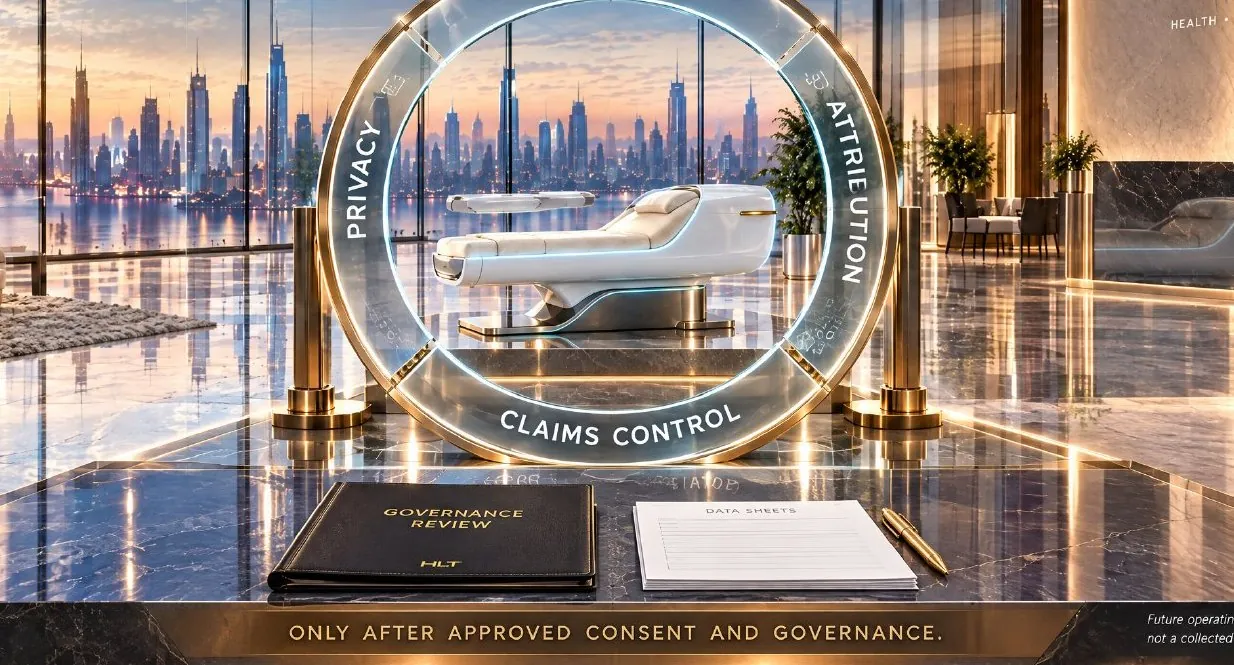
Data governance describes a future operating capability, not a collected audience or an owned database today.
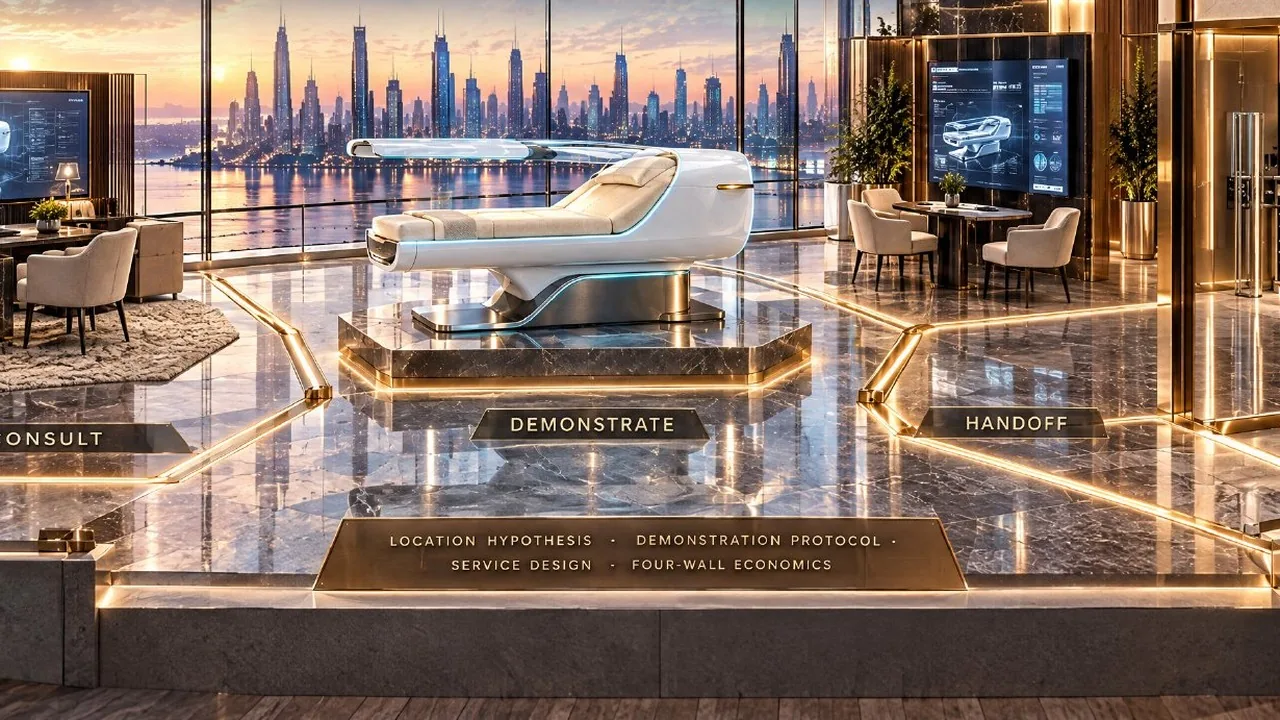
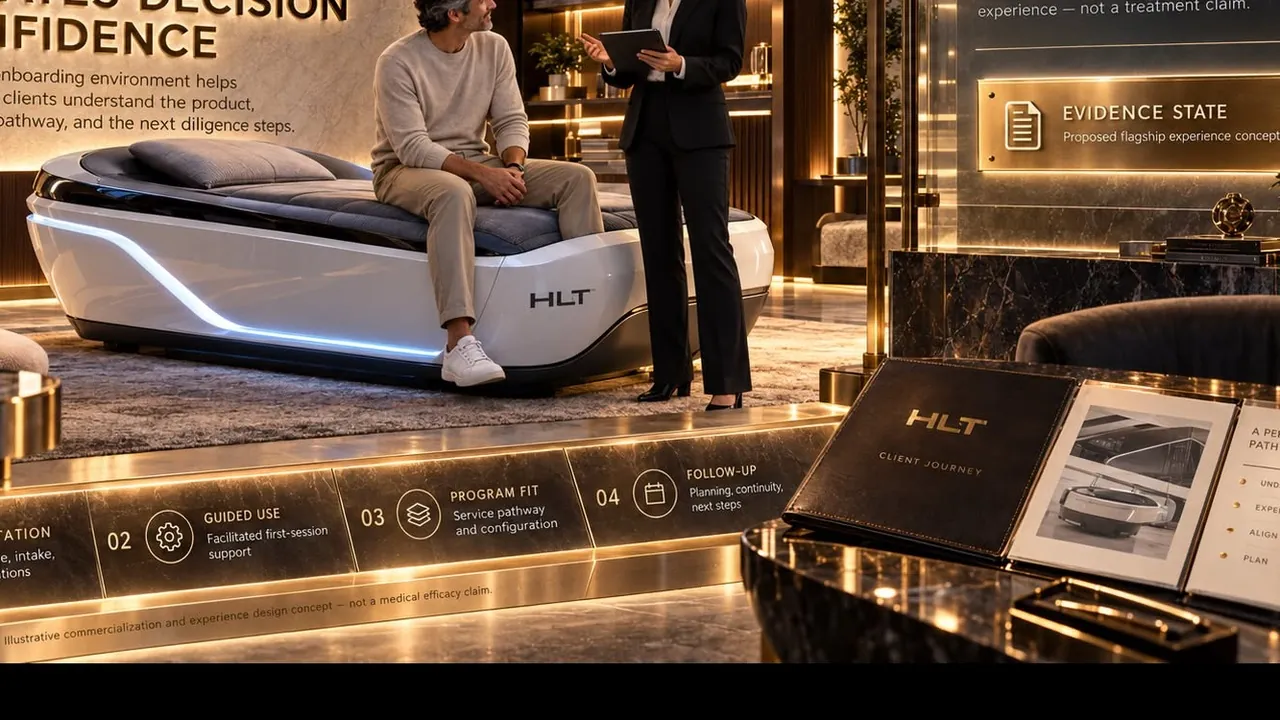
The flagship makes a complex purchase inspectable and explainable.
A MedBed is a high-consideration purchase. The flagship centre lets a buyer see, try and understand it before committing. It is a proposed commercialisation mechanism, not a treatment setting.
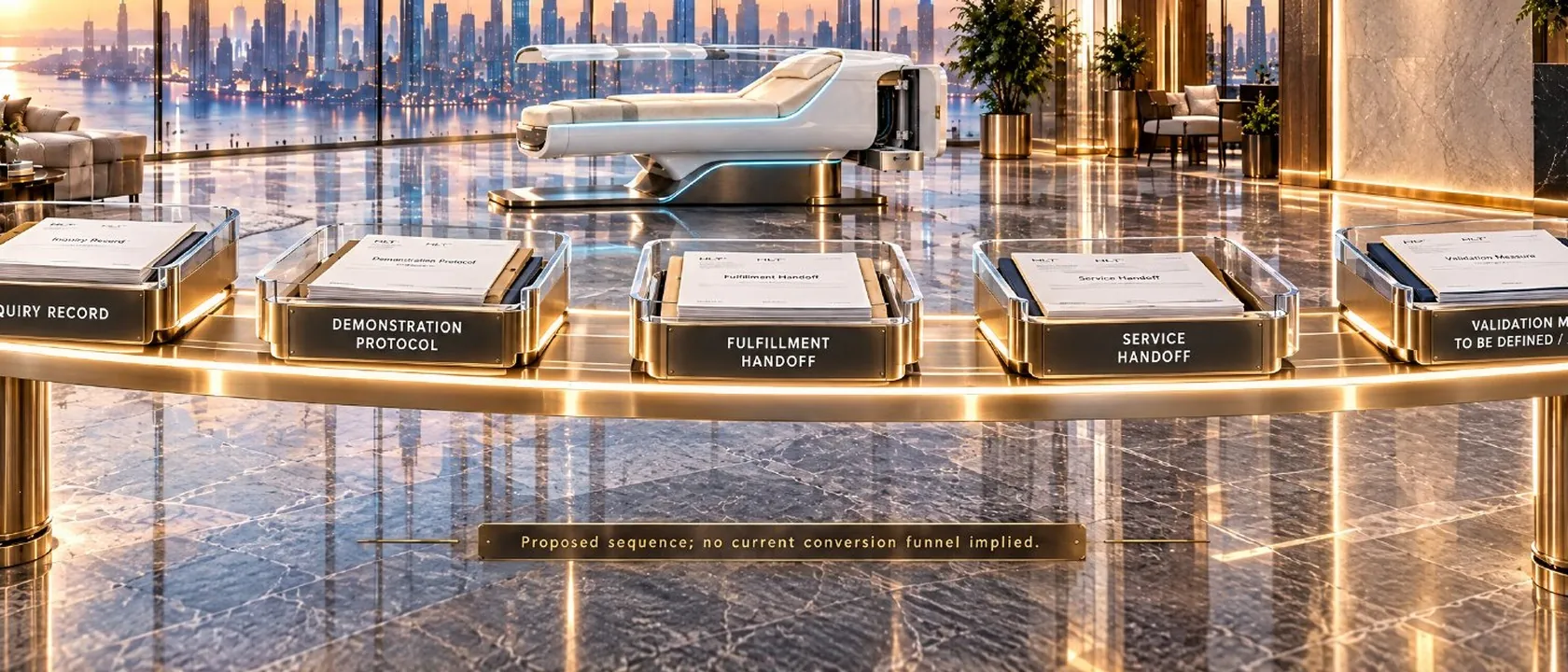
Controlled handoffs create the evidence trail.
Proposed customer path; not current conversion evidence.
Compare the buyer’s choice set, not only the product.
Category frame only: no HLT-specific market share, demand, differentiation or superiority is inferred.
Buyer alternative
What else could the buyer choose?
Experience
How does the visit compare?
Service
Who looks after it afterwards?
Fulfilment
How easily does it arrive and install?
Trust
Why should the buyer believe it?
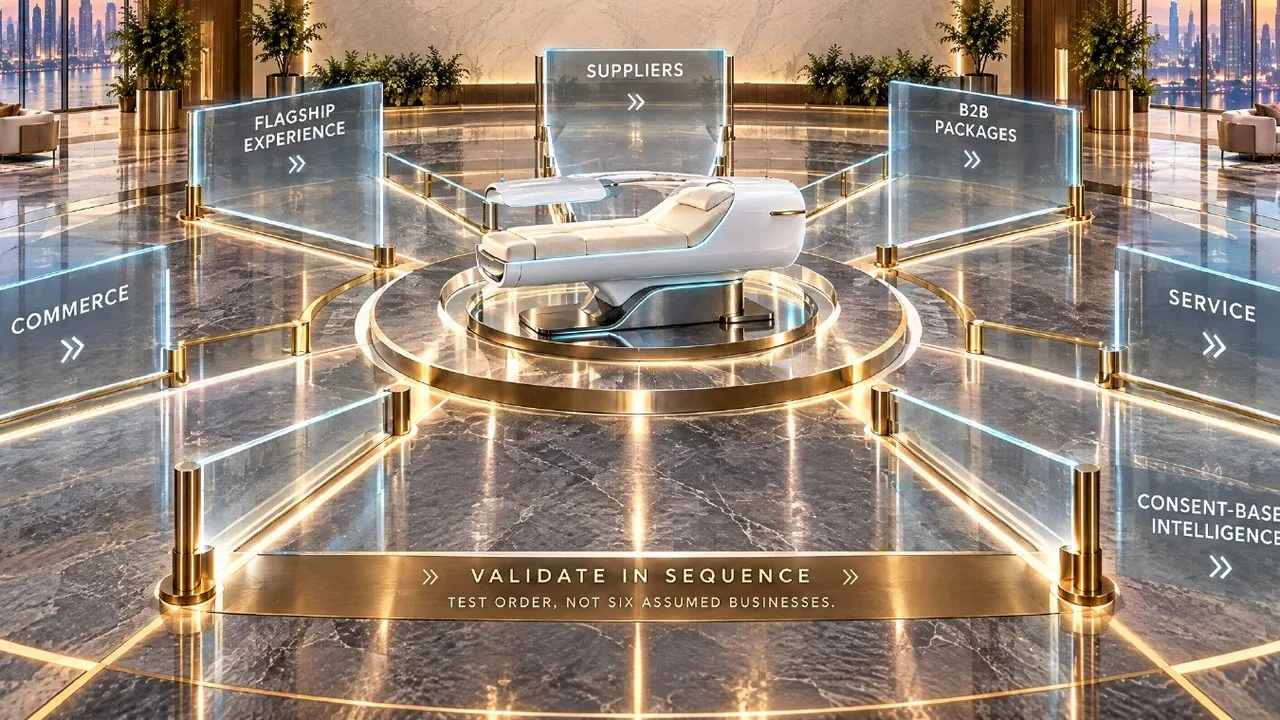
Six lanes. One test order.
The product is the anchor; the platform is the work around it. Each lane is validated in sequence, one test order rather than six assumed businesses, so each earns its capital with evidence before the next opens.
Flagship experience
What it is: Consult · demonstrate · hand off · service.
What it must prove: Location, traffic, demonstration protocol, four-wall economics.
Commerce
What it is: Core commerce & e-commerce.
What it must prove: Qualified demand, contribution logic, fulfilment, cash conversion.
Suppliers
What it is: Evidence-ready participation.
What it must prove: Rights, authorised role, supply terms, warranty, service allocation, concentration review.
B2B packages
What it is: Hospitality · residential · executive.
What it must prove: Pilot win rate, installation, service and cash conversion; hypotheses until signed.
Service
What it is: Installation · maintenance · lifecycle.
What it must prove: Uptime, documented procedures, parts traceability, recurring revenue.
Consent-based intelligence
What it is: Privacy-first, governed data.
What it must prove: Consent, privacy, attribution and claims control before any use.
Select a lane on the orbit. No channel, supplier or B2B setting is confirmed until source evidence is cleared.
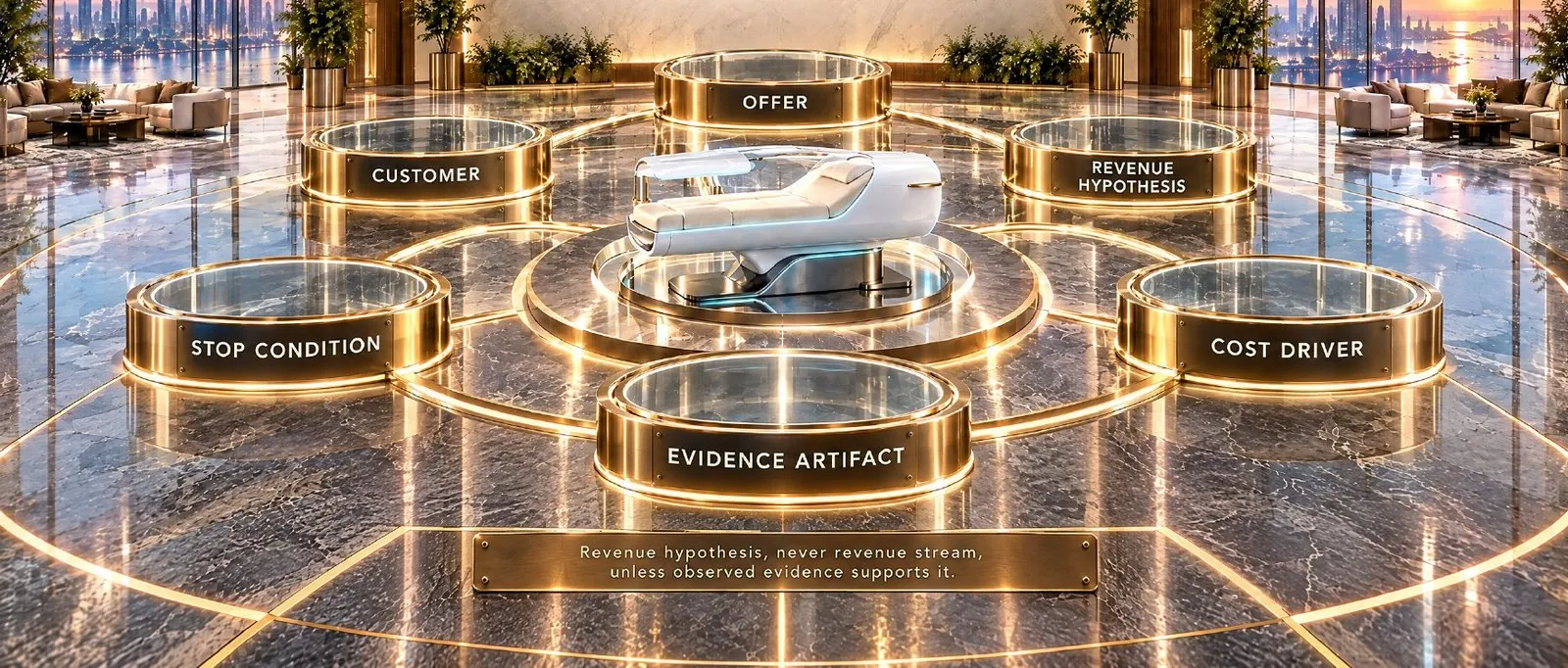
Make the economic loops repeatable before release.
Every revenue line is written as a loop with six parts. A revenue hypothesis never becomes a revenue stream unless observed evidence supports it.
| Lane | Starting monthly revenue | Growth / ramp | Gross margin | Activation | Evidence status |
|---|---|---|---|---|---|
| Core commerce | $165,000 | 0.8% / mo | 38% | Month 1 | Existing operating lane |
| E-commerce | $25,000 | 2.8% / mo | 40% | Month 1 | Modelled incremental lane |
| Showroom (flagship) | $20,000 | +$3,500 / mo | 42% | Month 10 | Site economics pending |
| Supplier commercialisation | $8,000 | +$2,200 / mo | 72% | Month 7 | Contracts pending |
| B2B | $12,000 | +$5,000 / mo | 42% | Month 10 | Pipeline pending |
| Lifecycle / service | $5,000 | +$1,600 / mo | 65% | Month 16 | Cohort data pending |
| Owned product | $20,000 | +$6,000 / mo | 50% | Month 31 | Strategic option, gated |
Ramp lanes grow by a fixed monthly increment to a cap (showroom $160K, supplier $100K, B2B $200K, service $65K, owned product $220K per month). Source: HLT Financial Model, Investor Draft v1, tab 02.
An operating business, not a concept.
HLT’s history has been reconstructed from bank statements. The same records show why capital matters now: liquidity is thin against throughput, and financing repayments have exceeded new draws. Staged capitalisation is designed to replace expensive short-term financing with a planned, evidence-gated programme.
| Metric | FY 2025 | H1 2026 | Reading |
|---|---|---|---|
| Statement deposits | $3,073,582 | $1,342,981 | Total bank deposits, not revenue |
| Selected commercial receipts | $2,124,276 | $992,953 | Corroborates ~US$2M operating scale |
| Merchant processor receipts | $1,536,587 | $865,043 | High confidence |
| Commercial wires / ACH | $587,689 | $127,910 | Medium confidence |
| Financing inflows | $439,057 | $56,900 | Separate from customer receipts |
| Financing repayments | $760,411 | $262,792 | Repayments exceed new draws |
| Average month-end balance | $18,806 | $7,965 | Thin liquidity relative to throughput |
Bank-reconstructed baseline from the main operating account. Commercial receipts corroborate operating scale; they are not audited GAAP revenue. Source: tab 03 Historical.
From US$2.6M to US$12.6M in five years.
The existing commerce base grows steadily. The new lanes, flagship showroom, B2B, suppliers and service, and later an owned product, each switch on at a set month, so that by Year 5 they contribute about two-thirds of revenue. Hover the bars for detail.
Modelled revenue by lane group, base case, US$ millions. Existing commerce = core commerce + e-commerce; suppliers & service = supplier commercialisation + lifecycle/service. Source: HLT Financial Model, tab 04 Revenue.
EBITDA-positive in Year 4.
Margins widen as higher-margin lanes, supplier commercialisation, service and the owned product, grow into the mix and fixed costs are absorbed. Inventory turns stay healthy at five to six times a year.
| Y1 | Y2 | Y3 | Y4 | Y5 | |
|---|---|---|---|---|---|
| Revenue | 2.62 | 4.52 | 6.93 | 10.07 | 12.56 |
| Gross profit | 1.04 | 1.94 | 3.10 | 4.63 | 5.82 |
| Contribution | 0.73 | 1.39 | 2.23 | 3.31 | 4.14 |
| Fixed operating costs | (1.41) | (2.20) | (2.50) | (3.11) | (3.53) |
| EBITDA | (0.68) | (0.81) | (0.28) | 0.20 | 0.61 |
| Depreciation & amortisation | (0.15) | (0.41) | (0.46) | (0.65) | (0.82) |
| Net income | (0.83) | (1.22) | (0.74) | (0.45) | (0.20) |
| Year 1 | Year 3 | Year 5 | |
|---|---|---|---|
| Gross margin | 39.5% | 44.8% | 46.3% |
| Contribution margin | 27.7% | 32.2% | 32.9% |
| EBITDA margin | –25.9% | –4.0% | +4.9% |
| Inventory turns | 5.4x | 5.9x | 5.6x |
| GM return on inventory | 3.5x | 4.8x | 4.9x |
Base operations $90K/month rising to $133K · showroom +$45K · B2B +$22K · suppliers +$12K · owned product +$32K · second location +$50K (from Year 4)
Customer acquisition cost, LTV/CAC and showroom sales per square foot are pending client data. Source: tabs 05, 06 and 11.
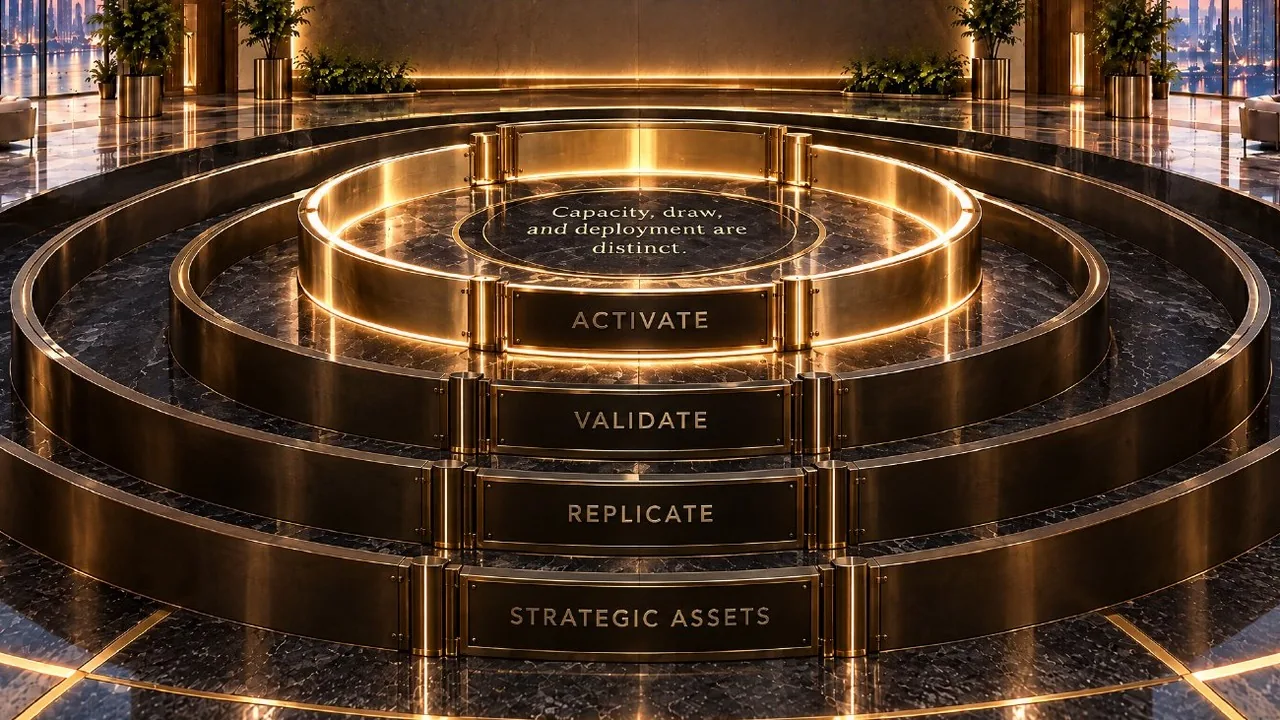
Staged capacity, not a single raise.
HLT’s capital is structured as cumulative programme capacity in three tiers. Capacity, draw and deployment are kept distinct: a higher tier opens only after the gate below it is passed.
Activation & validation
Gate: Baseline + activation evidence
Replication & regional expansion
Gate: Repeatable contribution, inventory & location economics
National-scale strategic assets
Gate: Repeatability, management depth, productive absorption
The model draws only what preserves a US$250K minimum cash floor and stays inside Tier I in every year. The base case is unlevered. Source: tabs 09, 10 and 13.
Capital released by evidence, not by assumption.
Three mechanisms keep every dollar accountable: a minimum activation set, a bounded validation loop, and a control system with stop-work rights.
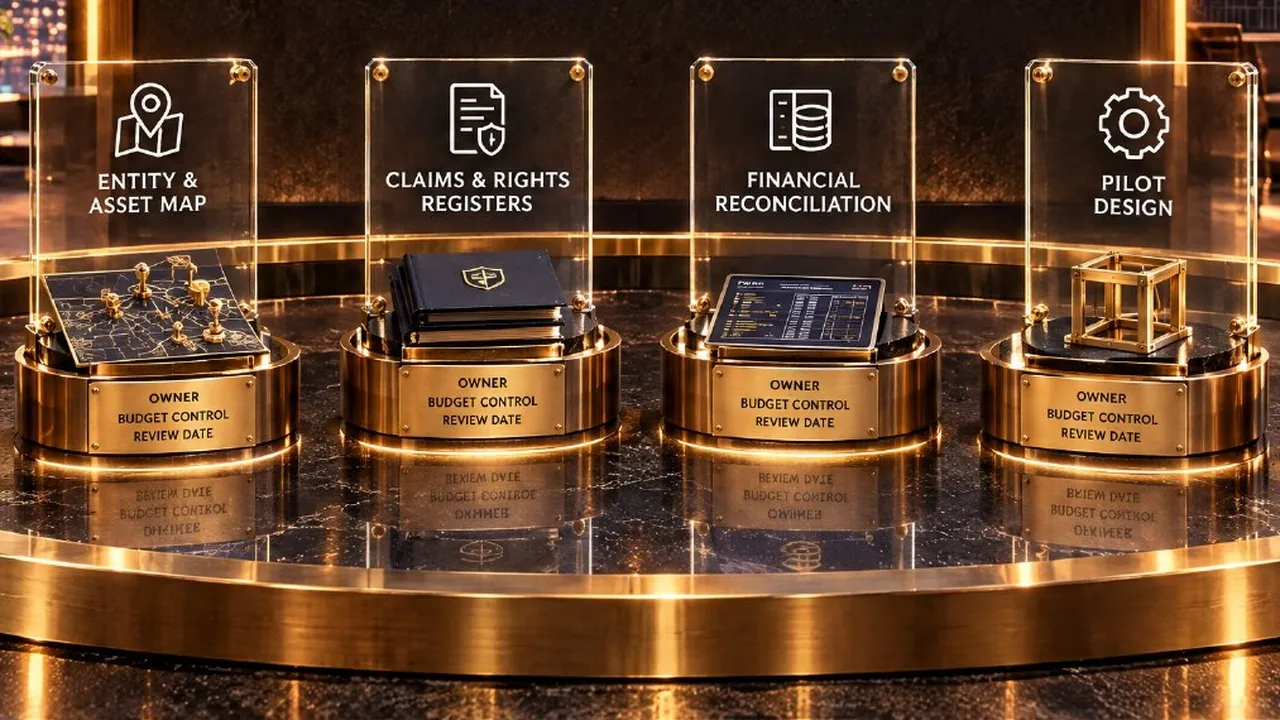
Activation buys the minimum capability to build the evidence base.
Each item has an owner, a budget control and a review date.
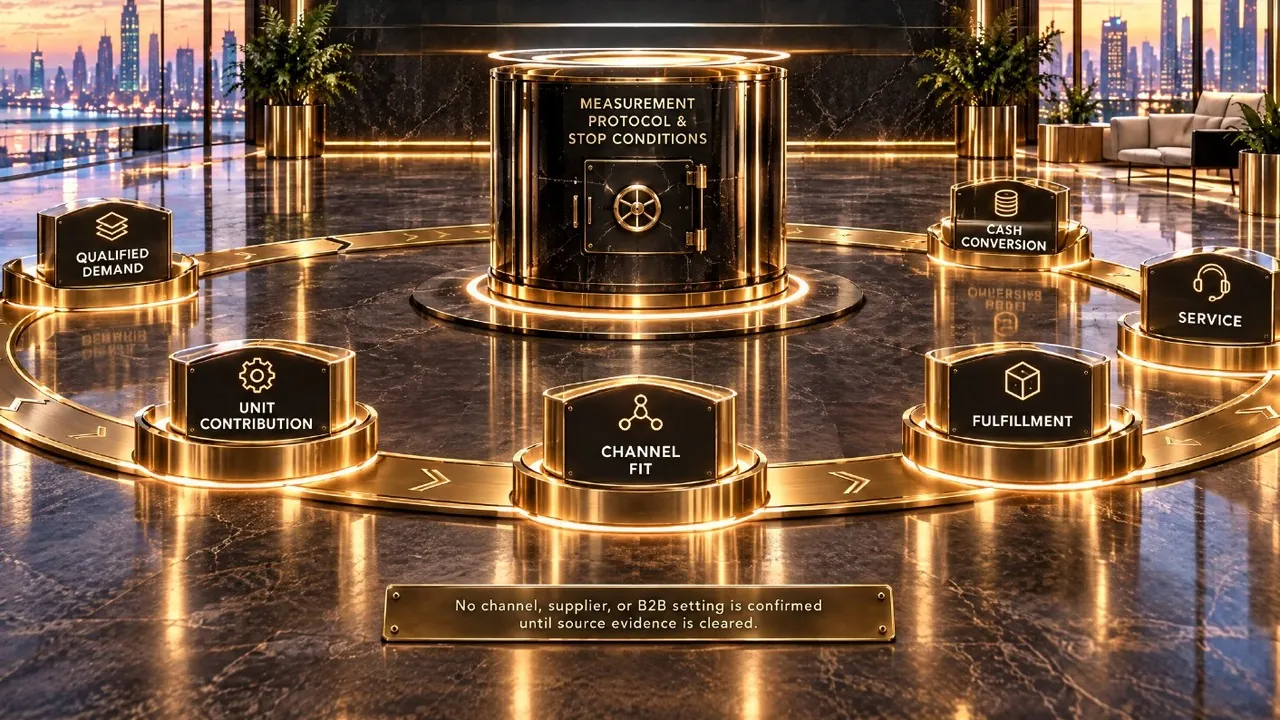
Validate a bounded commercial loop.
A measurement protocol and stop conditions sit at the centre of the loop.
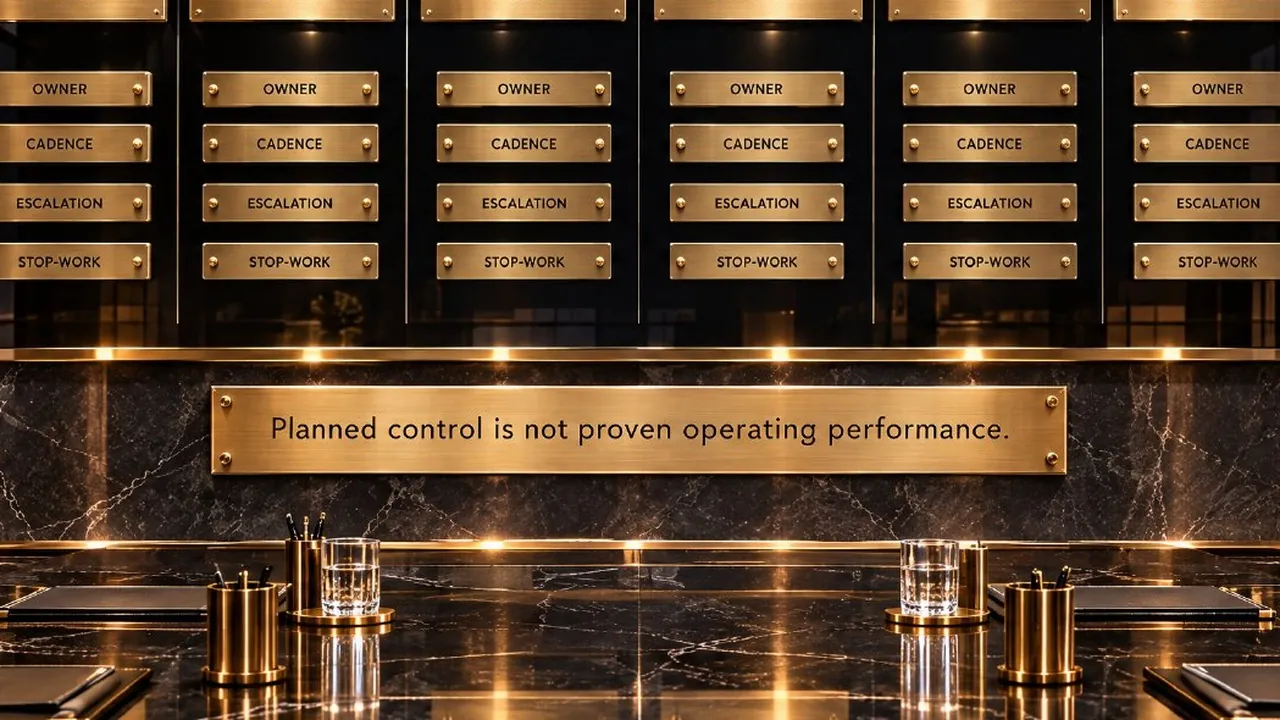
Capital protection is a control system.
Every control has an owner, a cadence, an escalation path and a stop-work right.
If readiness, claims, rights or service validation fails, product-forward scale does not release.
Proceed
The evidence supports release.
Redesign
Fix and re-test.
Pause
Hold capital until evidence arrives.
Stop
End the line; protect capital.
Stress-tested, optioned, and honestly valued.
Four scenarios flex demand, growth, margin, inventory and launch timing. Choose one to see how the drivers move.
Financing: the base case is unlevered. Inventory/ABL lines, equipment finance, landlord contributions, supplier terms and senior debt are optional layers once cash flow is proven.
The DCF is negative because Years 1–4 carry the build-out of the flagship, platform and second location; value is concentrated in the scaled business after Year 5. The model treats these figures as a feasibility range, not a negotiated transaction value, and leaves investment terms open.
Formal feasibility position: Conditional Go · capital architecture: evidence-gated. Source: tabs 14 and 15.
The first 90 days convert unknowns into decision evidence.
A proposed sequence; owners and dates remain proposals until accepted.
Product passport · entity–asset matrix · claims & rights register
Financial reconciliation · pilot protocol
Reporting framework · controlled data-room index
- SKU / vendor gross-margin data
- Current inventory, AP and supplier terms
- Outstanding financing balances and terms
- 2025 P&L, tax return or accounting export
Every figure, sentence and product image belongs to one class, so sources, models and hypotheses never blend.

From one flagship to a corridor network.
HLT scales the way its capital is released: one validated location first, then replication. Each new centre is an option exercised on evidence, not a commitment made in advance.
Richmond, Virginia · North America
HLT’s existing operating base and the first validation market: commerce, e-commerce, the first flagship showroom and the service team.
Antigua · Caribbean
A flagship MedBeds HLT™ centre inside the medical-tourism destination, alongside the German-standard hospital and resort.
Ethiopia · Horn of Africa
An HLT wellness centre in Addis Ababa, opened through the same evidence gates once the first flagship economics are proven.
London · United Kingdom
Corporate office for partners, governance, reporting and the European corridor.
The model’s second location activates in Year 4 and is gated on first-location four-wall economics.
To give nations the means to heal, feed and hydrate their people, by transferring validated, sustainable technology and building the institutions that carry it, from the first harvest to the first patient.
MedBeds HLT™ is where that mission meets a working business: an operating company with a premium product concept, a disciplined platform, a five-year path to EBITDA profitability and a capital programme that only moves when the evidence does.
Around it, Yalkoneh Engineering’s wider portfolio brings health, food, water and infrastructure to the Horn of Africa and the Caribbean. Phase I of that portfolio is proposed to be funded through a note facility, released in milestone-gated tranches, with HLT first in the order of deployment.
Ring-fenced accounts · independent trustee · validation before scale · quarterly reporting & audit · counsel-controlled process · stop rules
Every programme follows the same path: documented technology, independent validation, then milestone-released capital. Technical dossiers are available under NDA.

Begin the evidence-gated diligence conversation.
The data room, the technical dossiers and the partners are ready to meet.